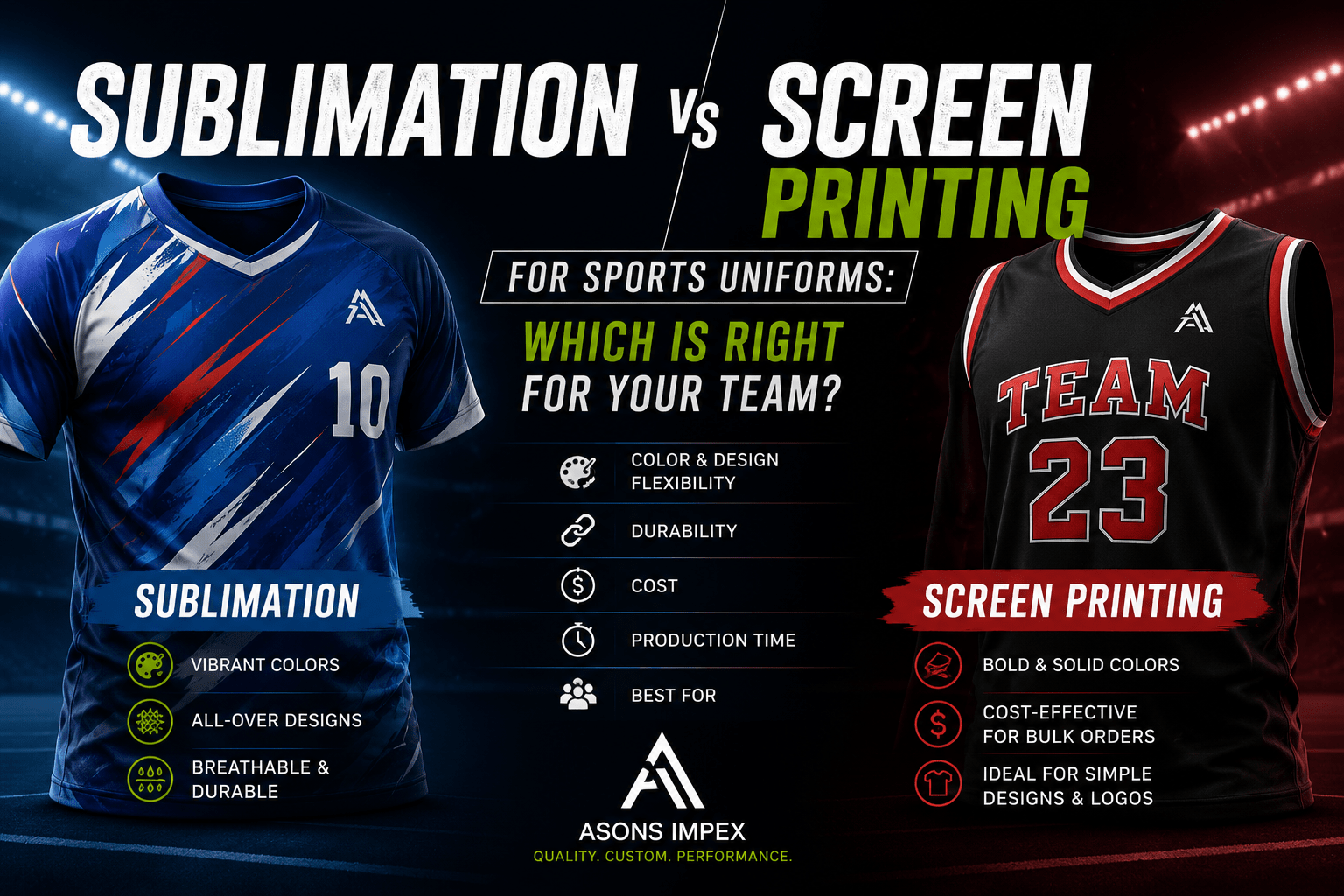
Sublimation vs Screen Printing for Sports Uniforms: Which Is Right for Your Team?

Last updated:
If you have ever asked a manufacturer about printing and gotten back a wall of technical jargon, this post is for you. Sublimation and screen printing are the two most common methods for sports uniforms. They work differently, cost differently, and suit different products. Embroidery comes up often enough that it deserves a place in the comparison too.
What sublimation printing is
Sublimation uses heat to transfer dye directly into polyester fabric. The dye bonds with the fibers rather than sitting on top of them. The result is a print that will not crack, peel, or fade even after repeated washing, because it has become part of the fabric itself.
This process works on 100% polyester only. If your fabric has more than about 5% cotton, the colors will come out muted and uneven.
Where sublimation works well:
- Full-color, all-over printed jerseys for soccer, basketball, cricket, and baseball
- Gradient designs and photorealistic prints
- Any design where you need consistent color across a large panel
- Performance sportswear where durability through washing matters
Where sublimation has limits:
- Cotton or cotton-blend fabrics (the dye will not bond properly)
- Dark base fabrics (sublimation colors print onto white or light-colored fabric)
- Orders where a raised, tactile feel is part of the design
What screen printing is
Screen printing pushes ink through a mesh screen onto the surface of the fabric. Each color in the design requires a separate screen. The ink sits on top of the material rather than bonding with it.
Screen printing works on a wide range of fabrics, including cotton, polyester blends, and fleece. It is the standard method for T-shirts, hoodies, and casual wear where the design is a logo or graphic rather than a full-panel print.
The limitation is color complexity. Each color requires a separate screen and a separate press setup, so a 10-color design costs significantly more than a 3-color one.
Where screen printing makes sense:
- Cotton or blend fabrics that cannot be sublimated
- Designs with 1 to 4 solid colors
- High-quantity runs where setup cost per unit drops substantially
- A tactile, slightly raised print feel
What embroidery is
Embroidery stitches the design directly into the fabric using thread. It is more expensive than printing for large areas but produces a durable, premium result for logos, crests, and wordmarks.
It is the right choice for polo shirts, tracksuits, caps, and coaching jackets where the branding is a defined logo. It does not work for complex designs with gradients or fine lines, and it adds weight and stiffness to the garment.
Cost comparison by quantity
Screen printing has high setup costs that fall sharply with volume. At 20 to 50 units, the setup cost per piece is significant. At 500+ units, it becomes very competitive.
Sublimation has low setup costs (it is essentially a digital process) and does not scale in the same way. The cost per unit stays relatively flat from 20 pieces to 200 pieces, which makes it the practical choice for smaller custom orders.
Embroidery is priced by stitch count and garment type. A small chest logo on 50 polo shirts costs less per unit than a large back-panel design on the same order.
A quick decision guide:
- Polyester jersey, full-color design, any quantity: sublimation
- Cotton or blend, simple logo or graphic, 200+ units: screen printing
- Polo shirt, tracksuit jacket, or cap with a logo: embroidery
- Mixed garment types with the same branding: embroidery for consistency across fabrics
Hybrid approaches
Some orders combine methods. A jersey might use sublimation for the base pattern and embroidery for the club crest. A hoodie might use screen printing for the main graphic and a small embroidered chest logo. This adds cost and coordination, but it is common in club and team orders where different garment types need to carry consistent branding.
Talk through the options with your manufacturer before finalizing your design files.
Get a quote for your specific order
Asons Impex produces sublimation jerseys, screen-printed casual wear, and embroidered branded apparel from Sialkot, Pakistan. Minimum order is 20 units per design. Lead time is 15 to 20 working days. Send your design reference to info@asonsimpex.com for a quote.