How to Choose a Custom Sportswear Manufacturer: 10 Questions to Ask Before Ordering

Last updated:
Picking the wrong sportswear manufacturer can set your project back by months. You might end up with fabric that pills after three washes, sizing that does not match your tech pack, or a factory that stops responding mid-order. It happens more often than people admit.
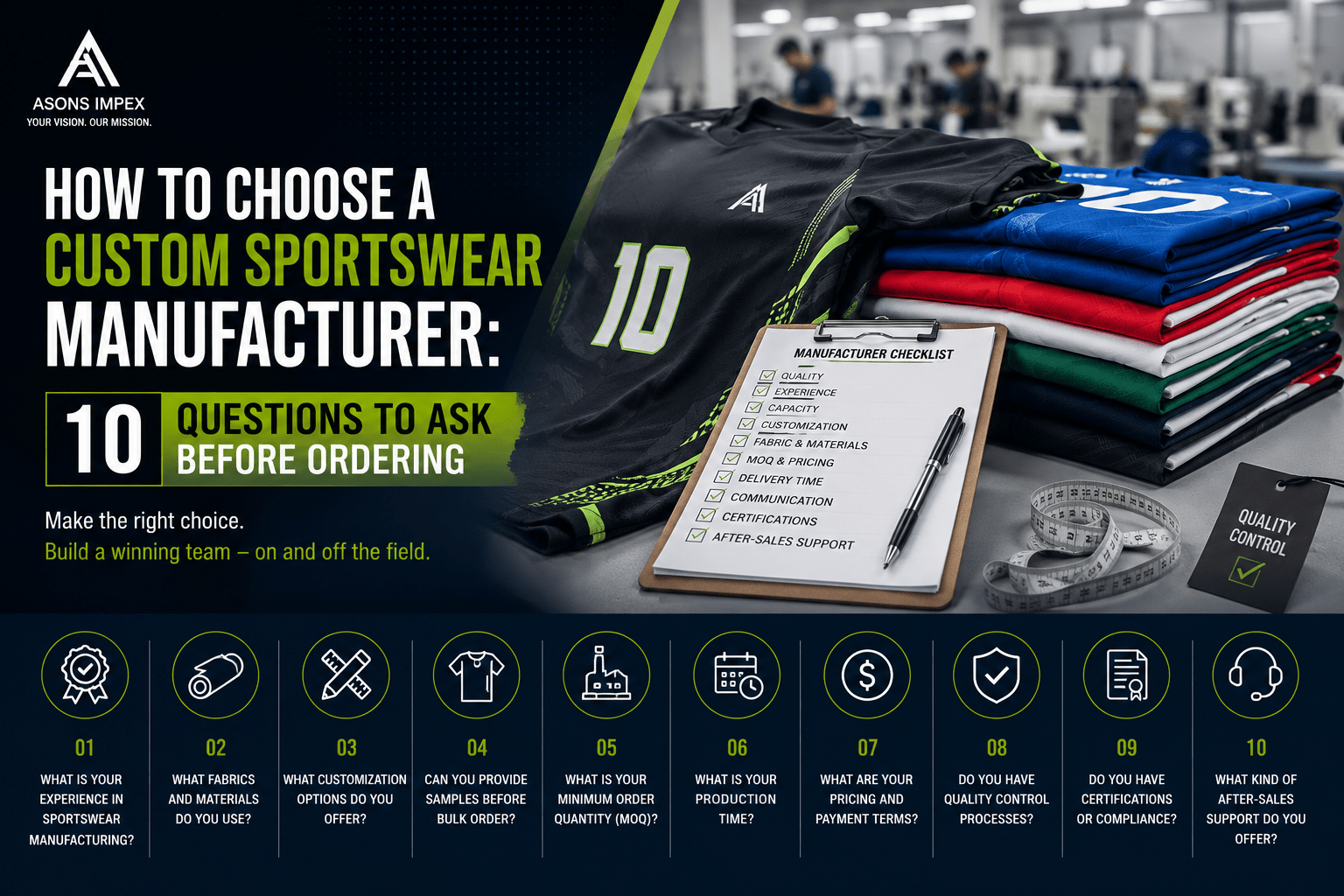
Most of these problems are avoidable if you ask the right questions before signing anything. Here are ten questions worth asking any manufacturer you are seriously considering.
1. Do you have in-house production or do you subcontract?
This matters more than it might seem. Factories that handle cutting, sewing, printing, and finishing under one roof have much tighter control over quality and lead times. Subcontracting introduces variables you cannot audit, and when something goes wrong, you find out who actually made your order only after the fact.
Ask to see photos of the production floor. A legitimate manufacturer will not hesitate to share them.
2. What is your minimum order quantity?
MOQs vary considerably. Some factories will not touch anything under 500 pieces. Others, particularly smaller Sialkot-based manufacturers, will work from 20 units per design. If you are launching a new product or testing a new market, that difference matters.
Get the MOQ in writing, and ask whether it applies per design, per colorway, or per SKU. These are not the same thing.
3. Can you produce a pre-production sample before bulk?
Any factory that will not send a physical sample before bulk production is a red flag. Samples let you check the fit, the print quality, the stitching, and the fabric weight before you are committed to 500 units of something that is wrong.
Ask who covers the sample cost and whether it is credited against the bulk order. Some factories charge a flat fee; others fold it in.
4. What fabric options do you carry in-house?
A factory with limited in-house fabric stock will subcontract fabric sourcing, which adds lead time and introduces inconsistency between orders. Ask specifically about GSM options, fabric compositions, and whether they can source performance finishes like moisture-wicking or UV protection.
If you are making sublimation jerseys, confirm they stock 100% polyester in the right weight. If you want cotton-poly blends for casual wear, ask whether they can match a reference swatch you send.
5. How do you handle size grading?
Size grading is where a lot of factories cut corners. Your tech pack might specify sizes XS through 3XL, but if the factory is grading manually rather than using pattern grading software, there will be fit inconsistencies across the size run.
Ask whether they use CAD/CAM pattern grading and whether they work from their own standard specs or entirely from your tech pack. If they use their own specs, ask to see them before you agree to anything.
6. What is your quality control process?
Any reasonable factory has some QC. What you want to know is where in the process it happens. Inline QC catches problems before they compound. End-of-line inspection alone catches them only after the order is finished, by which point you may be waiting for replacements rather than shipping.
Ask what percentage of garments they inspect, what they check for, and what happens when a batch fails.
7. Can you share references from clients in a similar category?
A factory that makes primarily soccer uniforms and has never produced yoga wear is not the wrong choice for yoga wear, but you should know they are working outside their main experience. Ask for references from clients whose orders were comparable to yours in terms of product type, order size, and customization level.
8. What are your payment terms?
Standard terms for B2B apparel manufacturing are 30 to 50% deposit to start production, with the balance due before shipping. Factories asking for 100% upfront with no sample commitment are a risk.
Also ask which payment methods they accept. Wire transfer is standard internationally.
9. How do you handle revisions and disputes?
You want to know this before it matters, not after. Ask specifically what happens if the bulk order does not match the approved sample, how claims are raised, and what documentation you need to support one.
A factory with a clear, documented process for handling disputes is less likely to vanish when something goes wrong.
10. What lead time can you commit to in writing?
Verbal lead time estimates are almost meaningless. Get the timeline in writing, including the start date (usually deposit receipt or sample approval) and the dispatch date.
- Ask for a production schedule with milestones, not just a single delivery date
- Confirm who covers express shipping costs if production runs late
- Get the written lead time confirmed after your deposit is received, not before
Order from a factory that answers all ten
At Asons Impex, we manufacture custom sportswear from Sialkot, Pakistan with a minimum order of 20 units per design. Lead time is 15 to 20 working days from sample approval. We handle cutting, sewing, printing, and finishing in-house and have been supplying B2B clients across 16 export markets since 2020. Contact us at info@asonsimpex.com or WhatsApp +92 303 525 0093.